
The key turns, you get a click or a weak groan, and the morning changes shape. A jump-start is often all it takes, but the order you connect the cables is not a ritual: batteries can vent hydrogen gas, and the final connection can make a small spark. Done in the right order, that spark happens far from the battery. Done wrong, it happens right next to it. Your owner's manual has the procedure for your specific car and it is the final word; here is the method most manuals and roadside organizations agree on, and the situations where a jump is the wrong tool.
Before you connect anything
Thirty seconds of checking is what separates a five-minute fix from an expensive mistake. AAA's pre-jump checklist:
- Look at the dead battery first. Cracks, bulging sides, or a rotten-egg smell mean leaking acid and possibly explosive gas. That battery gets replaced, not jumped, and it should not be handled more than necessary: battery acid is corrosive. If you must touch it, gloves and eye protection are the minimum, and this is a good one to leave to a shop or a mobile call.
- Confirm both cars are 12-volt. The voltage is printed on the battery label. A 24-volt system from a commercial truck can wreck a car's electronics.
- Park or neutral, parking brake set, both ignitions fully off. A live ignition on either side risks a voltage spike.
- Take off rings, watches and metal jewelry. A tool bridging the positive terminal to a ring causes severe burns.
- Position the cars close but not touching. Cables should reach easily with a few inches of air between the bumpers. If there is no room to work clear of traffic, or darkness and rain hide you from drivers, do not attempt it at the roadside at all.
The cable order, and why it works
This is the order AAA publishes and the same one Toyota prints in its owner's manuals. Where those connection points actually sit depends on the car: batteries hide under floors, seats and in trunks, and many cars provide dedicated jump posts under the hood instead of direct battery terminals. The illustration above shows the general idea, not the exact points for any specific model. Your owner's manual shows yours.
- 1. Red clamp to the dead battery's positive (+) terminal. It is usually marked and often has a red cover.
- 2. Other red clamp to the good battery's positive (+) terminal.
- 3. Black clamp to the good battery's negative (-) terminal.
- 4. Last black clamp to clean, unpainted metal on the dead car, like a thick bolt on the engine block. This is the step people skip. The last connection is the one that can spark, and grounding it on metal keeps that spark away from the battery and any gas around it.
- 5. Start the donor car and give it three to five minutes. Holding the revs slightly above idle charges faster on a cold morning.
- 6. Try the dead car. A slow, struggling crank means progress: give it five more minutes on the donor and try once more. Still nothing after a third try usually means the battery is done or something else is wrong, and more cranking will not fix it.
One rule runs through the whole job: never let the clamps touch each other while any of them is on a battery.
When not to jump at all
- A damaged battery. Cracked, bulging, leaking or smelling of rotten eggs: replacement, not a boost, and not something to handle more than you have to.
- Hybrids and EVs. Many makers warn against using one as the donor car because of their electronics, and their own 12-volt batteries often have a different procedure with dedicated terminals under the hood. Toyota's electric models, for example, have their own jump procedure in the manual. Check yours before connecting anything.
- A bad spot. No room clear of traffic, poor visibility, or a live lane beside you. No start is worth that risk; this is what a service call is for.
After the engine starts
- Leave the cars connected and running for three to five minutes so the freshly started car's electrical system stabilizes.
- Remove the cables in the exact reverse order: black off the grounding point, black off the donor, red off the donor, red off the started car.
- Drive for 20 to 30 minutes with the big electrical loads off (heated rear window, seat heaters, high fan). A jump gets the engine running and sustained driving starts putting charge back, but that is a minimum to keep things running, not a promise of a full battery. A deeply drained battery can need hours on a proper charger.
- Get the battery and charging system tested soon. A jump does not answer why the battery died. Sometimes it is a light left on; sometimes it is an aging battery or a drain. Toyota's manual goes further and says have the vehicle inspected after a jump. A battery that needed one boost often needs another at the worst time.
What that means in the Lower Mainland
Most Lower Mainland winters are kind, but the first real cold snap finds every weak battery at once, usually on a wet dark morning with the car parked outside. If the car clicked this morning, our clicking-when-you-turn-the-key guide helps you tell a tired battery from a starter problem before you reach for cables. And if the car keeps dying after successful jumps, the fall battery guide covers why cold weather exposes a battery that was already on its way out.
What a visit looks like
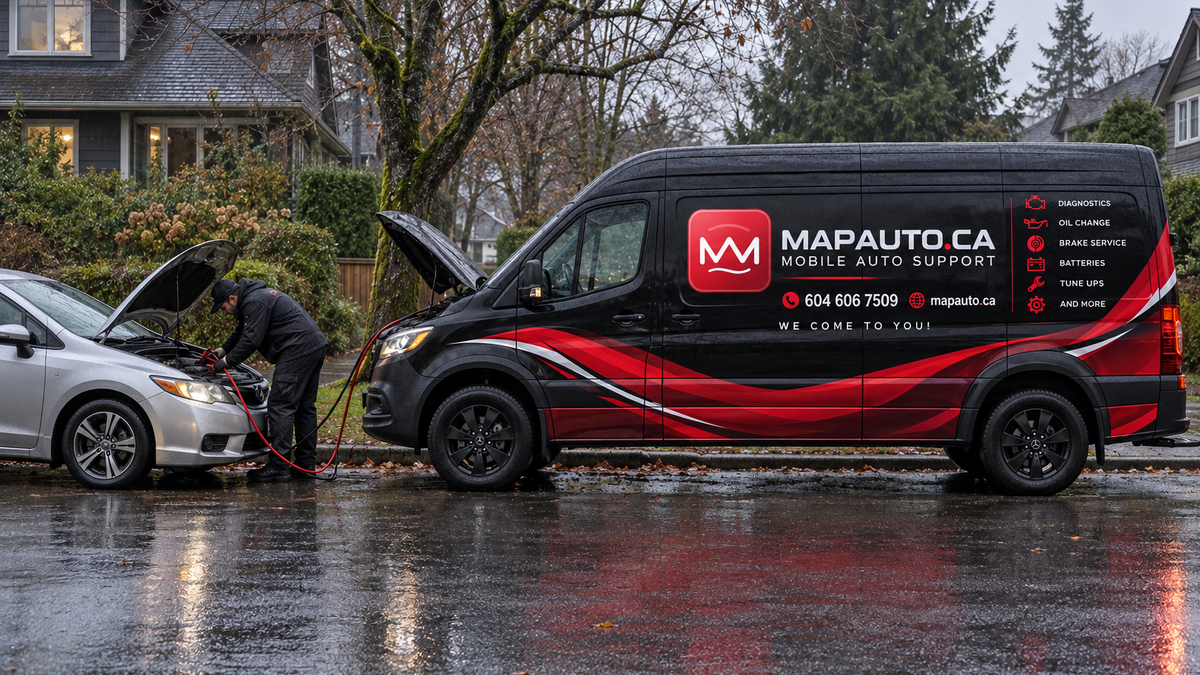
Call (604) 606-7509 and tell us where the car is. We come to you with a proper booster pack, test the battery and the charging system on the spot, and tell you straight whether it is a charge-and-go or a battery that is done. If it needs replacing, that can usually happen where the car sits.
Before you need it
- Carry real cables. Thin bargain cables struggle, especially on larger engines and in the cold. AAA suggests a heavy-duty set: six-gauge, 16 feet.
- Know where your battery actually is. Some cars hide it in the trunk or under a seat and give you jump posts under the hood instead. Two minutes with the manual now beats guessing in the rain.
- Know your grounding point. Many manuals show the exact bolt or bracket to use.
- If the battery has needed a boost before, plan the test now. Cold snaps are not the time to find out how weak it really is.
Common questions
Does the last clamp on bare metal really matter?
Yes. The final connection is the one that can spark, and batteries can vent flammable gas, especially when weak or overworked. Putting that spark on an engine bolt instead of the battery terminal keeps it away from the gas. It is a small step that costs nothing.
How long should I drive after a jump-start?
AAA's guidance is a continuous 20 to 30 minute drive with heavy electrical loads switched off, and short hops with lots of stopping do little. Treat it as a minimum to keep the car running, not a full recharge: a deeply drained battery can need hours on a proper charger. A test afterwards is the only way to know whether the battery will hold up.
Can I jump-start my hybrid?
Many hybrids and EVs have their own procedure, often with dedicated jump terminals, and many makers say not to use them as the donor for another car. The owner's manual is the authority here. If it is not clear, that is a good reason to call instead of guessing.
Related services
Call (604) 606-7509 and tell us where the car is. We come to you across the Lower Mainland, 7am to 7pm every day.