
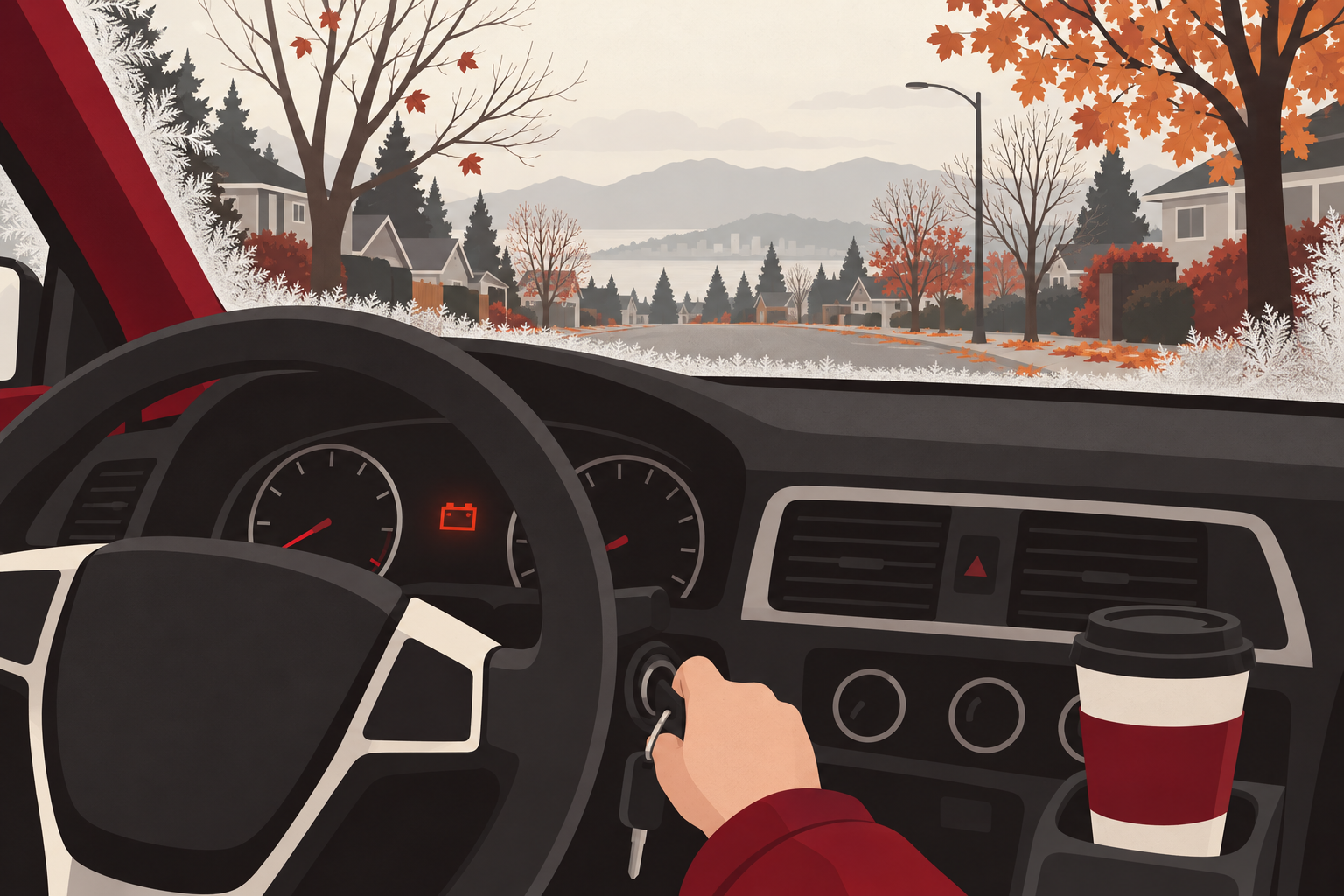
You turn the key on a cold morning and instead of the engine turning over, you get clicking. The good news: the sound itself is a useful clue. Different clicks point to different problems, and one of them is cheap and simple. Here is how to read what your car is telling you, what to check first, and when it stops being a driveway job.
What the clicking is telling you
- Rapid clicking, several clicks a second: usually a weak or dead battery. The starter solenoid tries to engage and the battery cannot hold it there. This is the most common cause of a clicking no-start, and cold mornings are when a borderline battery finally shows it.
- One heavy click, then nothing: usually points at the starter. The solenoid engages but the motor does not spin. A deeply drained battery or a poor connection can do the same thing, so this one earns a jumpstart attempt before anyone quotes a starter.
- No click at all: no power is reaching the starter circuit. That can be a fully dead battery, a loose or corroded connection, a blown fuse, or the ignition switch itself.
None of these patterns is a certain diagnosis on its own. Loose or corroded cables and connections can produce any of the three, and so can a wiring or switch fault. That is why the simple checks come first.
What to check first
- The terminals. With the engine off and the key out, look for white or blue-green crust on the battery posts and check whether either cable sits loose on its terminal. A corroded or loose connection can mimic a dead battery, and it is the cheapest fix on this list. If you clean or tighten anything yourself, never bridge the two posts with a metal tool and keep sparks and flames well away from the battery. Not sure? Leave it for the mechanic.
- The dash lights. A completely dark dash points at the battery or its connections. A bright dash with clicking points more toward the battery's charge or the starter.
- A jumpstart. If it starts with a jump and dies again within days, the battery or the charging system is the problem. Our battery light guide covers how the alternator fits in. If it still just clicks with a good jump, the starter moves to the top of the list, with the cables and connections between the battery and starter close behind.
One caution either way: do not keep cranking. Cranking over and over on a weak battery overheats the starter, and you can end up replacing both instead of one. A few short tries, then stop.
What a visit looks like
Call (604) 606-7509 and tell us what the car is doing. We come to you, test the battery under load, check the connections and the charging system, and test the starter draw, so you replace what actually failed and nothing else. If it is the battery, that is a swap we do on the spot. If it is the starter, we can handle that too.
Keeping it from happening again
- Know the battery's age. Most car batteries last three to five years, and cold weather is when an aging one gives up. If yours is in that window, a test before winter beats a surprise in a parkade.
- Watch the short trips. Lots of short drives never give the battery a full charge back. Our short trips post explains what that does over a winter.
- Keep the terminals clean. A quick look for corrosion every few months catches the easy problem early.
- Do not ignore a slow crank. An engine that turns over lazily on a mild day is telling you what a cold morning will make obvious.
Common questions
If it clicks, is it always the starter?
No. Rapid clicking usually means the battery cannot deliver enough power. The single heavy click is the pattern that points at the starter.
It started after a jump. Am I fine?
Not necessarily. A jump gets you going once, but if the battery is worn out or the alternator is not charging, you will be jumping it again. Get the battery and charging system tested soon so you know which it is.
Can I just replace the battery and see?
You can, and a lot of the time it works. But if the real problem is the starter, a connection, or the charging system, you have bought a battery you did not need and the click comes back. A proper test takes minutes and answers it for sure.
Related services
Call (604) 606-7509 and tell us what the car is doing. We come to you across the Lower Mainland, 7am to 7pm every day.