
You had a flat, the spare is on, and now the real question: how far can it actually take you? For a compact spare, the guidance printed on the tire and in most owner's manuals comes down to two numbers: no faster than 80 km/h, and only enough driving to reach a tire shop, commonly about 80 km in total. Your spare's sidewall and your owner's manual are the final word for your car. Here is why those limits exist, how they change with the kind of spare you have, and what to check before you need one.
Why the limit exists
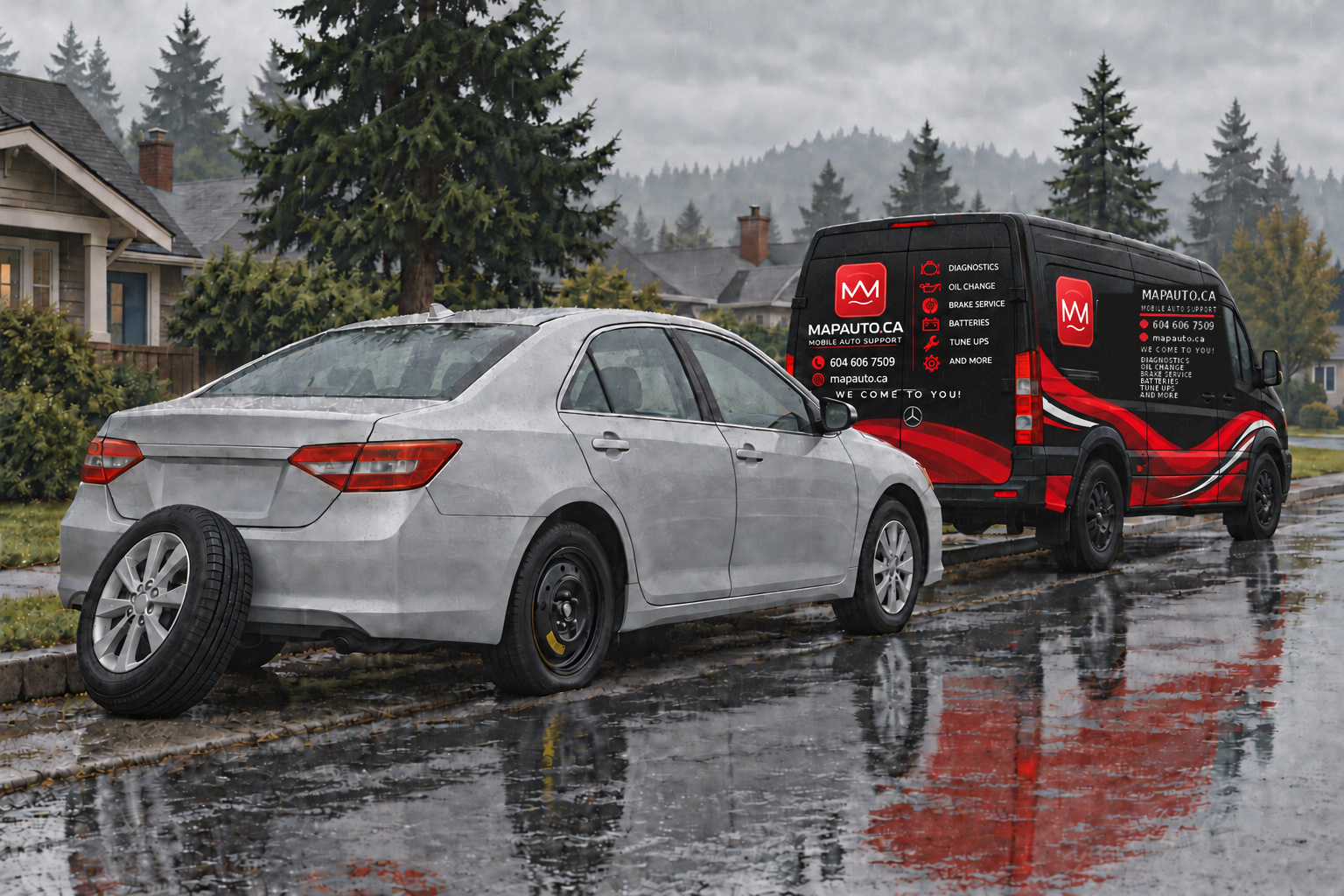
- Less rubber on the road. A compact spare, often called a donut, is narrower than your normal tire. Braking distances grow and cornering grip drops, and you feel it most in the rain.
- A different diameter. The smaller wheel spins faster than the other three, the car sits a little lower, and over distance the mismatch is hard on the drivetrain. All-wheel-drive cars are often the most sensitive to it, and some makers give specific instructions about which axle a compact spare goes on, so check the manual when you can.
- Not built for speed or heat. A donut is a light, temporary tire, usually marked "temporary use only" on the sidewall. Sustained highway speed builds heat it was never designed to handle.
- Your safety systems notice. Toyota's manual warns that systems like ABS, stability control and traction control may not operate correctly with the compact spare installed. Gentle driving is part of the deal.
The three setups you might have
- Compact spare (donut). The most common. The widely printed limits are 80 km/h and roughly 80 km of total driving; Toyota and Kia both print the speed limit in their manuals, and Kia specifies 60 psi for the spare itself. Drive gently: no hard acceleration, abrupt steering, or sudden braking. It is a ride to the tire shop, and every short trip counts against the same total.
- Full-size spare. If it matches your other tires and is properly inflated, it is the closest thing to normal driving, but get the flat repaired soon anyway: until you do, you have no backup at all. A full-size spare that does not match your other tires is a temporary tire too, so treat it like one.
- No spare at all. Many newer cars come with a sealant kit and a small inflator, or run-flat tires. Sealant only works on small tread punctures, not sidewall damage or a blowout. Run-flats usually allow a limited distance at reduced speed, and your manual gives the exact figure.
What that means in the Lower Mainland
A tire shop is rarely far away here, so use that: head straight there, gently, on surface streets where you can. What a donut is not for: the highway at speed, a trip over the Coquihalla, or days of errands. November rain makes the margin smaller still. A skinny spare on a wet road has noticeably less grip in braking and in standing water, so keep the speed down, leave extra room, and make the tire shop the only stop. If the flat happens somewhere awkward, our flat tire guide covers the safe way to handle the roadside part.
What a visit looks like
Call (604) 606-7509 and tell us where the car is. We come to you, swap the spare on with the right torque, and repair the flat on the spot when the puncture is repairable. Many tread punctures are. If the tire is done, we tell you straight and help you sort the replacement, instead of sending you off on a donut for longer than it should carry you.
Before you need it
- Check that you actually have a spare. Trunks of newer cars often hold a kit instead. Two minutes now beats finding out on the shoulder.
- Check its air. Donuts lose pressure sitting in the trunk, and many need far more than a normal tire, commonly around 60 psi. The sidewall and the manual give the exact figure for yours. A donut low on air is not safe to drive on.
- Know where the tools live. Jack, wrench, and the key for locking wheel nuts if your car has them.
- If there is no spare, decide the plan now. A sealant kit covers small punctures. A mobile call covers everything else.
Common questions
Can I take the highway on a donut?
Best avoided. If there is no practical alternative, keep to the right lane, stay under 80 km/h, and make it a short hop to the nearest exit and tire shop. Wet weather shrinks the margin further.
Can I drive on it for a week?
Not a good idea. The distance guidance is a total, not per trip. Days of errands can use it up faster than one careful drive to the shop. Treat it as a ride to a repair, nothing more.
No spare, no kit, flat tire. Now what?
That is a normal service call for us. We come to you across the Lower Mainland, and if the tire cannot be repaired where the car sits, we get you rolling with the least fuss.
Related services
Call (604) 606-7509 and tell us where the car is. We come to you across the Lower Mainland, 7am to 7pm every day.